
INWP Lender Spotlight: September 2026
Northern Ontario Housing & Mortgage Monthly
For clients in North Bay, Greater Sudbury, Muskoka, Sault Ste. Marie & Timmins — September 2026

Executive Summary - September 2026
September starts with a fairly familiar picture across Northern Ontario: sales activity is holding up reasonably well, inventory has improved in a number of markets, and buyers generally have more choice than they did a few years ago.
What has changed is the rate conversation.
The Bank of Canada held its overnight rate at 2.25% on September 2, as expected. For most borrowers, the bigger story now is not whether another rate cut is coming, but how long the Bank stays at 2.25%...and when the next move eventually comes.
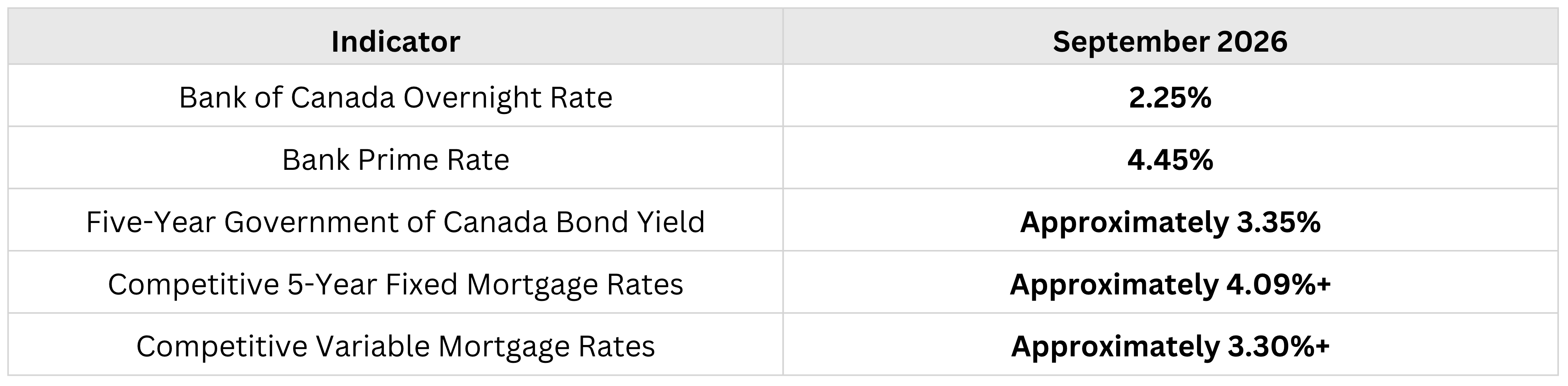
There is also a growing difference between the outlook for variable and fixed mortgage rates. Bank Prime remains stable, but Government of Canada bond yields have moved higher, which has put some upward pressure on fixed mortgage pricing.
For Northern Ontario buyers and investors, the backdrop remains fairly constructive. Prices are still much more attainable than in Southern Ontario, rental demand is holding up well, and a number of Northern markets continue to see healthy sales activity.
Interest Rates and Forward Outlook
The Bank of Canada held its policy rate at 2.25% on September 2.
At this point, another cut looks increasingly unlikely unless there is a meaningful deterioration in the economy. Inflation remains close enough to target that the Bank can afford to wait, but energy prices, trade uncertainty and other inflation risks make further easing harder to justify.
The interesting part is how divided the major banks are on what happens next.
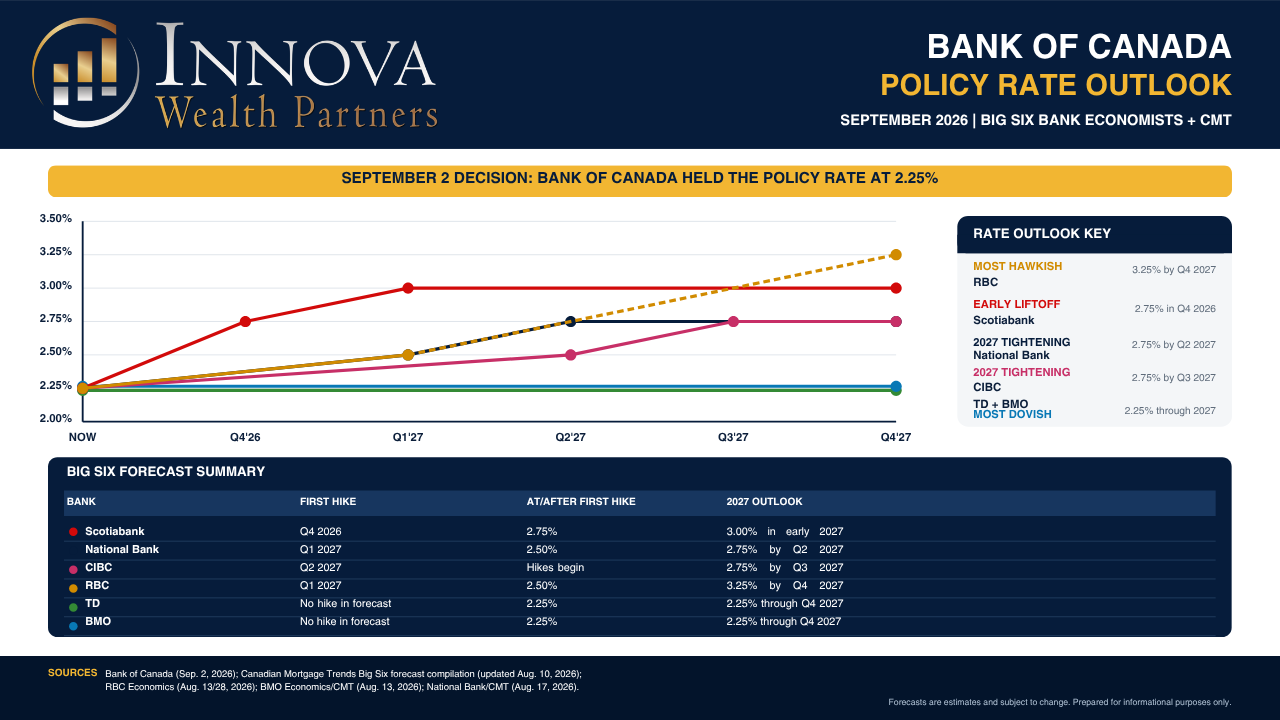
Scotiabank is at the more aggressive end of the spectrum, forecasting a hike as early as Q4 2026. RBC expects the policy rate to reach 3.25% by the end of 2027. TD and BMO, on the other hand, continue to forecast a 2.25% policy rate through the end of 2027.
That is a pretty wide range.
My view remains that the most likely outcome is a continued hold through the balance of 2026. The Bank does not appear to be in any rush to raise rates, but there is also very little reason at the moment to expect another meaningful round of cuts.
For borrowers, that means the rate decision is becoming more about strategy than simply trying to time the bottom.
Current Rate Environment
Fixed rates deserve particular attention.
The Bank of Canada controls the overnight rate, but fixed mortgage rates are influenced much more heavily by the bond market. Five-year Government of Canada yields have moved up from the levels we saw earlier in the summer, so fixed mortgage pricing has not benefited from the Bank of Canada being on hold to the same extent as variable-rate products.
For borrowers renewing or purchasing this fall, I would be looking at more than just the headline rate. Term length, prepayment privileges, refinancing plans and how long you expect to own the property all matter.
National and Ontario Market Trends
The broader Ontario market is still relatively soft, but Northern Ontario continues to look somewhat different.
Across several Northern markets, sales activity has held up well and pricing has been relatively stable. Inventory has increased in some areas, but not enough to create the kind of buyer's market being seen in parts of Southern Ontario.
That is particularly noticeable in North Bay, Sudbury and Timmins.
North Bay Market Snapshot

North Bay had a very strong July.
There were 175 residential sales, up 36.7% from July 2025, making it the strongest July in more than five years.
The average sale price was $513,251, up 8.5% year over year, while the benchmark price was $424,800.
Inventory has also improved. There were 475 active listings at month-end, but strong sales kept months of inventory at only about 2.7 months.
That is an important distinction. Buyers have more properties to choose from, but the market is not oversupplied.
Well-priced homes are still moving, particularly in the more affordable parts of the market. Higher-priced and more unique properties generally give buyers more negotiating room.
Market view: Balanced to slightly seller-favouring.
Sudbury Market Snapshot

Sudbury also posted a solid July, with 320 residential sales, up 7.7% year over year.
The average sale price was essentially unchanged at $499,198, while the benchmark price increased to $512,000.
There were 800 active listings and approximately 2.5 months of inventory.
What I find interesting about Sudbury right now is that sales volumes have improved without a major move higher in average pricing. Buyers have more options than they did during the peak market, but good properties are still attracting attention.
For investors, this continues to be one of the more interesting Northern Ontario markets. Employment is supported by mining, healthcare, education and government, and rental demand remains strong.
The caution is the same as always: a rental property should work on today's numbers. I would not underwrite a purchase based on aggressive rent increases or future appreciation.
Market view: Moderate seller's market, but with noticeably better selection for buyers.
Timmins Market Snapshot

The Timmins-area market remains tighter from an inventory standpoint.
There were 155 sales in July, up 9.2% year over year.
The average sale price increased to $327,594, while active listings fell to 366 — down more than 23% from last year.
Months of inventory sits at approximately 2.4 months.
For investors, Timmins continues to offer attractive entry prices and the potential for stronger cash flow than many larger Ontario markets. That said, older housing stock means property condition matters.
I would continue to pay close attention to roofs, foundations, electrical systems, plumbing, insurance costs and deferred maintenance. A cheap property can become expensive very quickly if those items are ignored.
Market view: Seller-leaning.
Sault Ste. Marie Market Snapshot

Sault Ste. Marie remains one of the more balanced Northern Ontario markets.
The latest complete board statistics show an average sale price of roughly $344,000, with close to 3.3 months of inventory.
Compared with Sudbury, North Bay and Timmins, buyers generally have a little more time and a little more negotiating leverage.
That can create opportunities, particularly on homes that need updating or have been on the market for a while.
For buyers who are comfortable with renovation work, the Sault remains worth watching.
Market view: Balanced.
Muskoka Market Snapshot

Muskoka remains difficult to summarize with a single number.
Waterfront, recreational, luxury and year-round residential properties can behave very differently, and current MLS reporting limitations make monthly comparisons less reliable than in the other markets covered here.
What is clear is that the recreational market is much more normal than it was between 2020 and 2022.
Buyers are generally taking more time, and higher-priced properties can sit longer unless they are well located and properly priced.
This is one of the markets where patience can pay off.
Market view: Balanced to buyer-friendly, depending on the property.
Rental & Investment Market
Rental fundamentals remain one of the stronger parts of the Northern Ontario story.
Northern communities continue to benefit from comparatively affordable purchase prices, limited purpose-built rental supply and reasonably stable employment bases.
That does not mean every rental property economically pencils.
The better opportunities tend to be properties where the deal makes sense using current rents, realistic expenses and a sensible allowance for vacancy and repairs.
For any multi-unit or secondary-suite property, I would want to confirm:
- legal use and zoning;
- fire-code compliance;
- current rents;
- utility responsibility;
- insurance costs;
- property taxes; and
- any deferred capital work.
Financing treatment can also vary significantly between lenders. One lender may use a simple percentage of gross rent, while another may use a rental offset or net-rental calculation. That can have a meaningful impact on borrowing capacity.
Lending Environment
Conventional lenders remain fairly disciplined.
Strong borrowers with clean credit, stable income and marketable properties still have plenty of options. Where things become more complicated is with self-employed income, investment properties, unusual property types or deals requiring quick closings.
That is where lender selection becomes important.
Private and alternative lenders continue to make sense in the right circumstances, particularly for renovation projects, bridge financing, non-traditional income and properties that do not initially qualify conventionally.
The main consideration is still the exit.
If a borrower is using private financing today, the plan should not rely entirely on the assumption that mortgage rates will be dramatically lower a year from now.
September Outlook
I do not see a major shift in the Northern Ontario market heading into the fall.
Buyers have more choice than they did a few years ago, but inventory is still relatively tight in several communities. Sellers can no longer assume that every property will attract multiple offers, but well-priced homes are still selling.
On the mortgage side, the market is becoming a little more nuanced.
The Bank of Canada appears comfortable holding at 2.25%, while the bond market is putting some pressure on fixed rates. At the same time, the major-bank forecasts are increasingly split on when the next rate increase could arrive.
For most clients, I would not try to make a mortgage decision based on predicting the exact next Bank of Canada move.
I would focus instead on cash flow, flexibility, expected holding period and the borrower's overall plan.
That is probably the more important takeaway this month: Northern Ontario real estate remains reasonably healthy, but both buyers and borrowers need to be more selective than they were a few years ago.
Sources
- Bank of Canada, interest-rate announcement and Monetary Policy Report
- Canadian Real Estate Association
- Ontario Real Estate Association
- North Bay and Area REALTORS® Association
- Sudbury Real Estate Board
- Timmins, Cochrane and Timiskaming Districts Association of REALTORS®
- Sault Ste. Marie Real Estate Board
- Lakelands Association of REALTORS®
- Canada Mortgage and Housing Corporation
- Canadian chartered-bank economic forecasts
- Canadian mortgage-rate comparison data
If you want a personalized renewal, purchase, or investment analysis, just email
Thanks for reading!
Caleb O'Connor, CFP
Partner | Financial Planner | Mortgage & Lending Lead, Innova Wealth Partners
Mortgage Agent Level 1, HomeLink Financial Corp, Brokerage Lic. #10875
📩
This publication is for informational purposes only and shall not be construed to constitute any form of advice. The views expressed are those of the author alone. Opinions expressed are as of the date of this publication and are subject to change without notice and information has been compiled from sources believed to be reliable. This publication has been prepared for general circulation and without regard to the individual financial circumstances and objectives of persons who receive it. You should not act or rely on the information without seeking the advice of the appropriate professional.
- Hits: 962